
A Guide to Dreams and Sleep Experiences
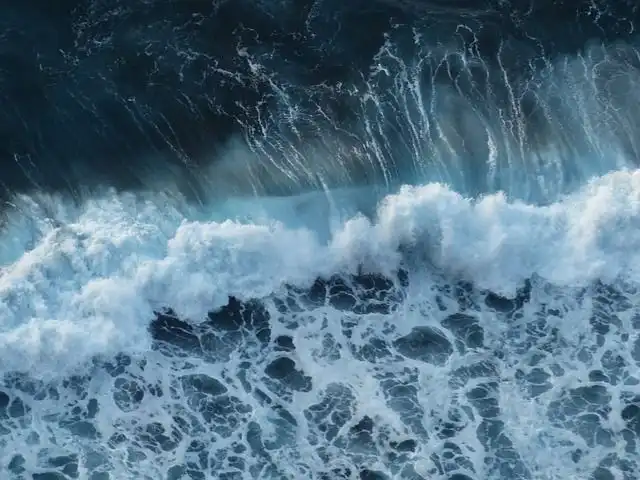
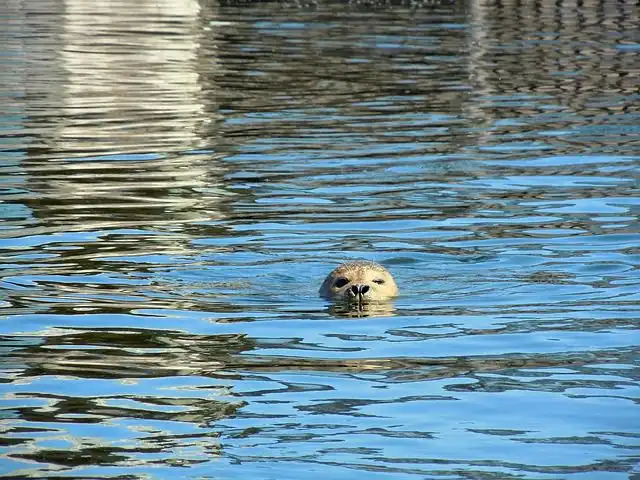
by Tony CrispThe sea, with its surface and hidden depths, lends itself to depicting this human experience of known and unknown regarding self.
The enormity of the sea is also a visible image of the enormity of our own inner world, most of it unknown, and also the relationship we have with the universe, which we exist in yet know so little about.
The sea holds vast treasures, curiosities, and our history—not simply because life emerged from the sea. or our blood is as salt as the ancient sea, but because so many ships and shorelines are now beneath the waves. Sometimes these can be recovered, and this depicts our remembering or making conscious.
Example: ‘My husband and I were standing looking at the sea’s surface. It was just falling night. I saw a mass of dark shapes, thought it would be a school of fish. Then we were looking at water birds, maybe ducks, again dark shapes as the light had almost gone. Then there was a hole in the sea, like a belly button, I was wondering what it was, how was it being made, was there something under the water? Something very big was coming up to the surface very close to me. It shot me to wake (Ginny Q). Ginny and her husband had been exploring the content of their dreams.
The image of the sea shows Ginny sensing there are enormous depths to her own being, and something big—a previously unconscious complex of insights and feelings—is becoming conscious.
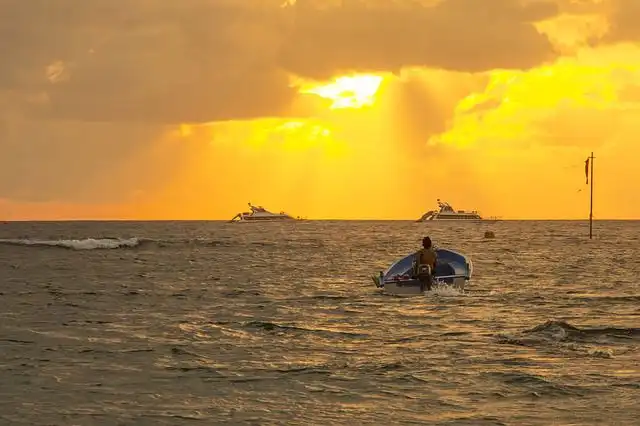
So, generally the sea represents the boundary between unconscious and conscious; our processes of life and the ongins of our life; the wisdom, still unverbalised because locked in process rather than insight, of our existence; source of the huge life drives, such as that which urges us towards independence, mating and parenthood, a symbol of infinite energy or consciousness, in which human existence is only a tiny pan. Example: A small speed boat was at sea. But the sea dissolved anybody who fell in. One man fell in but held himself together as a blob of water and jumped back to the speedboat. I remember the words “The sea is a great solvent” (Tim P). Tim is aware of his unconscious sense of being a pan of the huge sea of life or energy. In it one might lose one’s sense of identity. In the end, identity is ‘held together’ by one’s own belief in oneself.
Going under the sea: bringing internal contents to consciousness; remembering the womb expenence; letting our ego surrender a little, looking at death.
If there is a sense of hugeness, depth: going beyond the boundaries of experience usually set up by our conscious self or ego. Waves: impulses, feelings and emotions, such as sexuality, anxiety, anger. Tide: rising and falling of feelings such as love, pleasure or sexuality; may refer to aging when going out; tide in our affairs. Example: *l am either standing at the edge of the sea or near, when suddenly enormous tidal waves appear in the distance and are coming closer. I know they will engulf me, I turn and run away. Sometimes they do overtake me, other times I wake up’ (Mrs AV). We can run from pleasure and wider insight, just as much as from pain or fear. Idioms: all at sea, plenty more fish in the sea, lost at sea.
See beach; fish, sea creatures.
A Dictionary of Dream Symbols
by Eric AckroydSee also Baptism.
(2) The sea may be a mother symbol.
If so, it may represent either your own mother or Mother Nature. Drowning or fear of drowning would then symbolize (a fear of) being suffocated by a dominating mother or mother-attachment; or an unconscious death-wish.
See also Dead / Death, section (4).
(3) Sea may symbolize the feminine, or any aspect of it (e.g. intuition, receptiveness). For a male dreamer, therefore, going to sea may symbolize getting acquainted with the feminine in himself - the anima (See Brother / Sister, sections (4)-(6))
(4) Sea may symbolize creative potential. In mythology, water existed prior to creation, and the creator-god wresded with the sea-goddess and either made the world from her dismembered body or else impregnated her so that she gave birth to the world. Psychologically, therefore, the sea may symbolize the existence, within your psyche, of potential - the latent raw materials - for the creation of your true and total self.
(5) In mystic-meditative traditions there is the belief that the multiplicity of natural phenomena are merely different forms of one ultimately real thing (God, Brahman, Ultimate Reality, the One); and the One is commonly symbolized by the ocean, and the individual person or thing by a drop of water which eventually rejoins the sea from which it originally came. Freudians, like Moussaieff Masson, in his book. The Oceanic Feeling, may say that, if this piece of imagery appears in your dream, it signifies a death-wish, as in (2) above. Jungians would say it is a message from your unconscious concerning the disillusionment that awaits you if you continue to build your life round the ego, instead of acknowledging the One (life-force, God, or whatever you care to call it). Whether the Freudian or the Jungian interpretation fits you better should be easy to decide.
See also Introduction, pages 8-10.
The Big Dictionary of Dreams
by Martha ClarkeIt is the boundless freedom and yet comforting sweetness of the mother’s womb. (See WATER, DROWNING, BLUE, BOAT, LAKE, MOTHER, and MOON)
In primitive myths, the sea existed before the world. It was uterus of other living beings. The sea is a symbol of raw materials and is associated with the creative potential of our being. From a spiritual perspective, it can represent the whole. We are each the drops that form part of it. According to some superstitions, falling into the sea ensures good health; and dive into it and emerge just before waking ensures that current difficulties will be overcome.